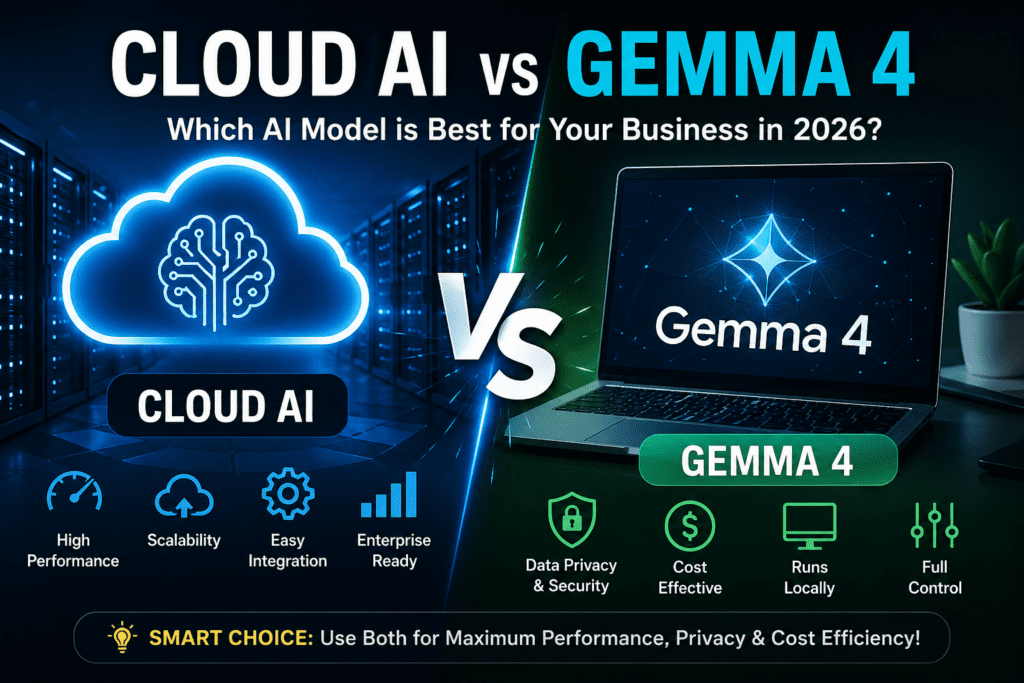
Artificial Intelligence is evolving rapidly, and businesses today are faced with a crucial decision should they rely on cloud-based AI models or switch to open-weight models like Gemma 4?
With the rise of powerful AI tools, choosing the right model can directly impact your cost, scalability, privacy, and performance. In this blog, we will break down everything you need to know about Cloud AI vs Gemma 4, helping you make the best decision for your business in 2026.
What is Cloud AI?
Cloud AI refers to artificial intelligence models that are hosted on remote servers and accessed through APIs. Instead of running the model locally, users send requests to cloud platforms and receive responses instantly.
Popular Cloud AI platforms include:
- OpenAI
- Google Cloud AI
- Microsoft Azure AI
These platforms offer highly advanced models capable of handling complex tasks such as natural language processing, coding, automation, and data analysis.
Key Benefits of Cloud AI
- High Performance: Access to state-of-the-art models
- Scalability: Easily handle millions of requests
- No Hardware Required: Everything runs on cloud servers
- Easy Integration: APIs simplify implementation
However, cloud AI comes with ongoing costs and potential data privacy concerns.
What is Gemma 4?
Gemma 4 is a powerful open-weight AI model developed by Google. Unlike cloud AI, Gemma 4 can run locally on your own hardware, giving you complete control over your data and infrastructure.
It is designed to be lightweight yet efficient, making it accessible for developers, startups, and businesses looking for cost-effective AI solutions.
Key Features of Gemma 4
- Open-weight model (customizable)
- Runs locally on devices or private servers
- Supports text, reasoning, and coding tasks
- Commercial use allowed (developer-friendly license)
Gemma 4 represents a shift toward decentralized AI, where businesses are no longer fully dependent on cloud providers.
Cloud AI vs Gemma 4: Detailed Comparison
Let’s compare both technologies across key parameters:
1. Performance and Accuracy
Cloud AI models are currently the most advanced in the world. They are trained on massive datasets and continuously updated.
Gemma 4, while powerful, is optimized for efficiency rather than raw performance.
Verdict: Cloud AI wins in performance.
2. Cost and Pricing
Cloud AI operates on a pay-as-you-go model. Costs can increase significantly with usage.
Gemma 4, on the other hand, is free to use. The only cost involved is hardware and maintenance.
Verdict: Gemma 4 is more cost-effective.
3. Data Privacy and Security
Cloud AI requires sending your data to external servers, which may raise privacy concerns.
Gemma 4 runs locally, ensuring complete data control.
Verdict: Gemma 4 is better for privacy.
4. Ease of Use
Cloud AI is beginner-friendly. You can start using it with just an API key.
Gemma 4 requires setup, configuration, and sometimes technical expertise.
Verdict: Cloud AI is easier to use.
5. Scalability
Cloud platforms are built to scale effortlessly.
Gemma 4 is limited by your system’s hardware capabilities.
Verdict: Cloud AI is better for large-scale applications.
6. Customization
Cloud AI models have limited customization options.
Gemma 4 allows fine-tuning and complete control.
Verdict: Gemma 4 wins in customization.
Use Cases: When to Choose Cloud AI
Cloud AI is ideal for businesses that need:
SaaS Applications
If you are building a product with thousands of users, cloud AI ensures smooth performance and scalability.
Data Analysis and Automation
Cloud platforms provide advanced tools for analytics and automation workflows.
AI Chatbots and Assistants
For highly intelligent and conversational AI, cloud models deliver the best results.
Fast Deployment
If you want to launch quickly without dealing with infrastructure, cloud AI is the right choice.
Use Cases: When to Choose Gemma 4
Gemma 4 is perfect for:
Privacy-Focused Applications
Healthcare, finance, and legal industries benefit from local AI processing.
Budget-Conscious Startups
No API costs make it ideal for startups with limited budgets.
Offline AI Tools
Run AI without internet dependency.
Custom AI Solutions
Fine-tune models for niche applications.
Hybrid Approach: The Smart Strategy in 2026
Many businesses are now adopting a hybrid AI strategy, combining both cloud AI and Gemma 4.
How it works:
- Use Cloud AI for complex tasks
- Use Gemma 4 for local processing and cost saving
This approach balances:
- Performance
- Cost efficiency
- Data security
Challenges of Cloud AI
Despite its advantages, cloud AI has some limitations:
- Ongoing subscription costs
- Data privacy concerns
- Dependency on internet connectivity
- Vendor lock-in
Challenges of Gemma 4
Gemma 4 also comes with its own challenges:
- Requires technical setup
- Needs powerful hardware for best performance
- Slightly lower accuracy than top cloud models
- Limited scalability compared to cloud platforms
Future of AI: Cloud vs Open Models
The future of AI is moving toward flexibility and control. While cloud AI will continue to dominate high-performance applications, open models like Gemma 4 will empower individuals and businesses to build independent AI systems.
We are entering an era where:
- AI becomes more accessible
- Costs decrease
- Privacy becomes a priority
Which One Should You Choose?
Choosing between Cloud AI and Gemma 4 depends on your goals:
Choose Cloud AI if:
- You need top-level performance
- You want easy setup
- You are building scalable applications
Choose Gemma 4 if:
- You want full data privacy
- You need cost-effective AI
- You prefer customization and control
Conclusion
Both Cloud AI and Gemma 4 are powerful in their own ways. While cloud AI leads in performance and scalability, Gemma 4 stands out for privacy, cost-efficiency, and flexibility.
The best choice is not about picking one over the other it’s about understanding your business needs and choosing the right tool accordingly.
As AI continues to evolve, businesses that adopt the right strategy will gain a significant competitive advantage in 2026 and beyond.