What is Cloud AI?
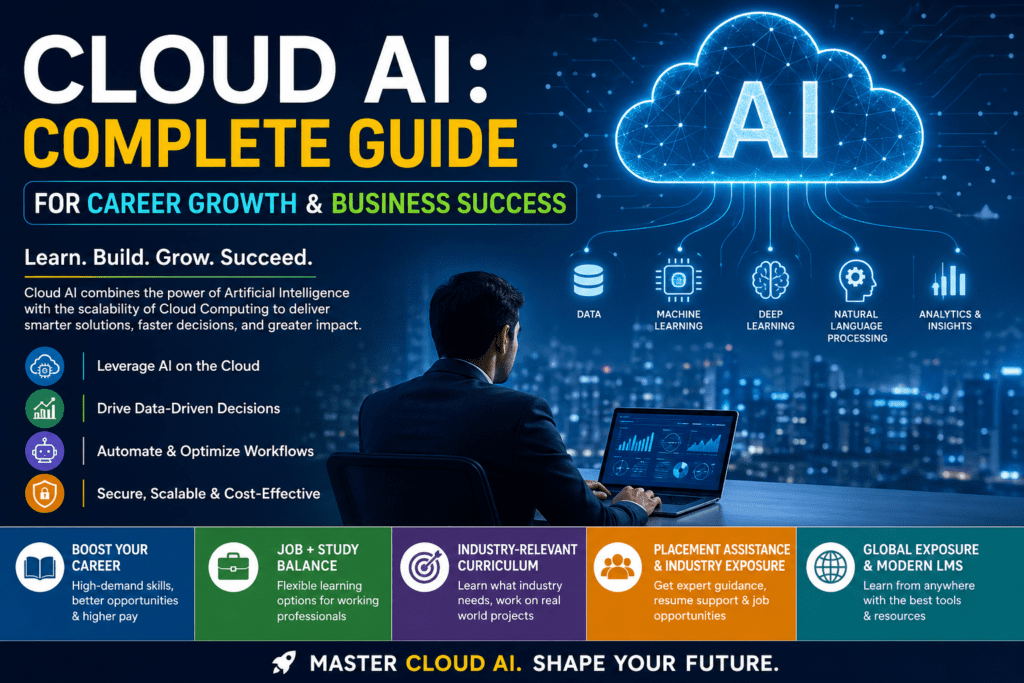
Cloud AI is artificial intelligence and machine learning services delivered over the internet by cloud providers. Instead of building AI systems on your own servers, you access pre-built AI tools, machine learning platforms, and data processing capabilities through the cloud. You pay for what you use, scale instantly, and deploy AI solutions in days instead of months.
The Rise of Cloud AI
Artificial intelligence is no longer a luxury for large corporations. Cloud AI has democratized access to powerful machine learning tools that were once available only to tech giants like Google, Amazon, and Microsoft.
Why Cloud AI matters today:
- Businesses reduce AI implementation costs by 60-70%
- Solutions deploy 5x faster than traditional AI
- Companies of all sizes now compete on equal footing with AI
- Data-driven decision-making becomes standard practice
- Automation eliminates repetitive work across industries
Whether you’re a business owner, developer, data analyst, startup founder, or enterprise decision-maker, understanding Cloud AI is essential for staying competitive in 2024 and beyond.
What is Cloud AI?
Definition
Cloud artificial intelligence combines three core components:
- Cloud Computing – On-demand access to powerful servers and storage via internet
- Artificial Intelligence – Machine learning models that learn from data
- Integration Layer – APIs and tools that connect everything seamlessly
How It Differs from Traditional AI
| Aspect | Cloud AI | Traditional AI |
|---|---|---|
| Infrastructure | Cloud provider’s servers | Your own data centers |
| Cost | Variable (pay-as-you-go) | Fixed (high capital investment) |
| Setup Time | Days to weeks | Months to years |
| Scalability | Unlimited | Limited by hardware |
| Maintenance | Provider manages everything | Your IT team’s responsibility |
| Data Storage | Centralized cloud storage | On-premise servers |
| Security | Enterprise-grade encryption | Depends on your setup |
| Expertise Required | Intermediate (APIs provided) | Advanced (build from scratch) |
| Time to ROI | 2-6 months | 1-2 years |
How Cloud AI Works: Step-by-Step
The Three-Stage Process
Stage 1: Data Collection & Preparation
- Gather data from websites, apps, databases, sensors, and user interactions
- Clean and organize data (remove errors, handle missing values)
- Store data in cloud data warehouses
- Example: Netflix collects millions of user viewing records daily
Stage 2: AI Model Processing
- Machine learning algorithms analyze patterns in data
- Models train on historical data to recognize patterns
- AI learns what recommendations work, what content sells, what users prefer
- Example: ChatGPT processes text patterns to generate human-like responses
Stage 3: Intelligent Output & Automation
- AI delivers insights, predictions, recommendations, or automated actions
- Results integrate with your business applications instantly
- Continuous learning improves accuracy over time
- Example: Amazon’s recommendation engine automatically suggests products in real-time
Real-World Example: E-commerce Personalization
Customer visits website → Cloud AI analyzes browsing history →
Machine learning predicts product preferences →
Personalized product recommendations displayed →
Customer sees relevant products (higher conversion) →
AI learns from purchase behavior
Key Benefits of Cloud AI
1. Cost Efficiency (30-50% Savings)
- No infrastructure investment: Pay cloud providers instead of buying servers
- Scalable pricing: Use resources only when needed
- Reduced staffing: Don’t need large data science teams
- Faster ROI: See returns within 2-6 months
- Example: Startup implementing Cloud AI might spend ₹50,000/month vs. ₹10 lakhs/month for traditional AI
2. Speed & Agility (5x Faster Deployment)
- Quick launch: Deploy AI solutions in days, not months
- Pre-built models: Use ready-made AI models instead of building from zero
- Rapid iteration: Test, learn, improve in weeks
- Competitive advantage: Beat competitors to market
3. Unlimited Scalability
- Automatic scaling: Handle 100 users or 100 million users seamlessly
- No capacity limits: Grow without infrastructure bottlenecks
- Global reach: Serve customers worldwide with minimal latency
- Peak handling: Process millions of transactions during high-traffic periods
4. Advanced Security & Compliance
- Enterprise encryption: Military-grade data protection
- Compliance ready: Meets GDPR, CCPA, ISO 27001, HIPAA standards
- Data backup: Automatic redundancy and disaster recovery
- Audit trails: Complete visibility into data access and usage
5. Automatic Updates & Maintenance
- No server management: Cloud provider handles updates and patches
- Always current: Access latest AI models automatically
- Zero downtime: Updates happen without disrupting service
- Improved performance: Continuous optimization by providers
6. Easy Integration
- API-first design: Connect to existing systems via APIs
- Pre-built connectors: Link to Salesforce, SAP, Shopify, databases instantly
- Webhook support: Trigger actions in real-time
- Multi-platform support: Works with any programming language
Cloud AI Use Cases by Industry
E-Commerce & Retail
Product Recommendations
- Analyze customer browsing, purchase history, and similar users
- Personalized product suggestions increase sales by 25-30%
- Real example: Flipkart, Amazon use this heavily
Inventory Management
- Predict demand based on trends, seasonality, weather
- Optimize stock levels (reduce overstock by 20%)
- Prevent stockouts on popular items
Fraud Detection
- Identify suspicious transactions instantly
- Reduce fraud losses by 40-60%
- Protect customer data and trust
Marketing & Advertising
Customer Segmentation
- Group customers by behavior, demographics, preferences
- Create targeted campaigns for each segment
- Increase email open rates by 35-50%
Predictive Analytics
- Predict which customers will churn
- Identify high-value customer prospects
- Optimize marketing spend ROI
Content Personalization
- Deliver customized messages via email, SMS, push notifications
- A/B test automatically to find best-performing variations
- Increase conversion rates by 20-40%
Finance & Banking
Fraud & Risk Detection
- Monitor thousands of transactions per second
- Flag suspicious patterns instantly
- Reduce fraud by 50-70%
Credit Scoring
- Assess creditworthiness using alternative data
- Approve loans faster (minutes instead of days)
- Expand lending to underserved populations
Algorithmic Trading
- Analyze market data to identify trading opportunities
- Execute trades at optimal prices
- Improve returns and manage risk
Healthcare
Diagnostic Assistance
- Analyze medical imaging (X-rays, MRI scans)
- Detect diseases like cancer earlier
- Support doctors with AI-powered insights
Drug Discovery
- Accelerate research and development (5-10x faster)
- Reduce drug development costs by 30-40%
- Identify promising compounds automatically
Patient Predictions
- Predict patient no-shows, readmissions, complications
- Enable preventive care interventions
- Improve patient outcomes and reduce costs
Customer Support & Service
AI Chatbots
- Handle 80% of routine customer questions automatically
- Reduce support costs by 30-50%
- Available 24/7/365 without fatigue
Ticket Routing
- Automatically route support tickets to right department
- Assign tickets to best-suited agent
- Reduce resolution time by 40%
Sentiment Analysis
- Monitor customer feedback across channels
- Identify unhappy customers for proactive outreach
- Measure customer satisfaction automatically
Manufacturing & Operations
Predictive Maintenance
- Predict equipment failures before they happen
- Reduce downtime by 50%
- Extend equipment lifespan
Quality Control
- Detect defects in products instantly
- Reduce defect rates by 25-35%
- Maintain consistent quality
Supply Chain Optimization
- Forecast demand accurately
- Optimize logistics routes
- Reduce waste and improve efficiency
Popular Cloud AI Platforms & Services
1. Amazon Web Services (AWS) – SageMaker
What it does: Complete machine learning platform for building, training, and deploying models
Best for: Enterprise organizations, large-scale ML projects, companies with AWS infrastructure
Key features:
- AutoML for automated model building
- Pre-trained AI models (computer vision, NLP)
- Managed Jupyter notebooks for development
- Model deployment and scaling
- Cost tracking and optimization
Pricing: Pay-as-you-go, typically ₹1,000-₹1,00,000+/month depending on usage
Use case: Netflix uses SageMaker to power recommendation algorithms
2. Google Cloud – Vertex AI
What it does: End-to-end AI/ML platform with pre-built models and custom training
Best for: Data science teams, organizations heavy in data, companies using Google services
Key features:
- AutoML Tables for tabular data
- Pre-trained vision and language models
- BigQuery integration for data analysis
- MLOps for model management
- Vertex Pipelines for automation
Pricing: ₹500-₹50,000+/month depending on compute and training needs
Use case: Google’s own search and Gmail use Vertex AI for intelligent features
3. Microsoft Azure – Cognitive Services & Machine Learning
What it does: AI services including vision, language, decision-making, and ML
Best for: Enterprises using Microsoft ecosystem, organizations needing enterprise support
Key features:
- Pre-built cognitive APIs (vision, speech, language, search)
- Azure Machine Learning for custom models
- Conversational AI and chatbots
- Knowledge mining and document intelligence
- Enterprise-grade security and compliance
Pricing: Varies by service, typically ₹2,000-₹1,00,000+/month
Use case: Microsoft uses Azure Cognitive Services in Office 365 for intelligent features
4. IBM Cloud – Watson
What it does: Enterprise AI platform for business applications
Best for: Large enterprises, regulated industries (banking, healthcare), complex solutions
Key features:
- Watson Studio for data science
- AutoAI for automated machine learning
- Pre-built AI models
- Enterprise security and compliance
- Industry-specific solutions
Pricing: Custom pricing, typically ₹5,00,000+/month for enterprise
5. Open-Source & Hybrid Options
TensorFlow (by Google)
- Free, open-source ML framework
- Full control over model building
- Requires data science expertise
- Best for: Developers with deep ML knowledge
PyTorch (by Meta)
- Popular for research and deep learning
- Flexible and Pythonic
- Strong community support
- Best for: AI researchers and academic institutions
Cloud AI vs. Traditional AI: Complete Comparison
Implementation Timeline
Cloud AI: Launch in 2-4 weeks
Traditional AI: Takes 6-12 months
Total Cost of Ownership (5-year)
Cloud AI: ₹50-100 lakhs
Traditional AI: ₹5-10 crores (50-100x more)
Team Requirements
Cloud AI: 2-3 people can build solutions
Traditional AI: Need large team (data engineers, scientists, DevOps, infrastructure)
Maintenance & Updates
Cloud AI: Automatic, zero downtime
Traditional AI: Your team manages everything, causes outages
Scalability
Cloud AI: Automatic, infinite
Traditional AI: Manual scaling, limits based on servers
Time to First Result
Cloud AI: 1-2 weeks
Traditional AI: 3-6 months
How to Get Started with Cloud AI: 5-Step Implementation Plan
Step 1: Define Your Business Problem (1-2 weeks)
What to do:
- Identify specific problems AI can solve
- List measurable goals (increase sales by 20%, reduce costs by 30%)
- Understand your current data landscape
- Calculate expected ROI
Questions to ask:
- What decisions could be better automated?
- Where are we losing money due to inefficiency?
- What customer pain points can AI solve?
- Do we have data available?
Deliverable: Clear problem statement and success metrics
Step 2: Evaluate Cloud Platforms (1-2 weeks)
Comparison factors:
- Ease of use (no-code vs. code-based)
- Pricing transparency
- Available pre-built models
- Integration options
- Support quality
- Compliance requirements
Action:
- Create free accounts (AWS, Google Cloud, Azure all offer free tiers)
- Test with sample data
- Compare pricing
- Check documentation quality
Deliverable: Selected platform with justification
Step 3: Prepare Your Data (2-4 weeks)
Critical steps:
- Collect all relevant data from various sources
- Clean data (remove duplicates, handle missing values)
- Organize and structure data properly
- Create training and test datasets
- Document data quality issues
Why this matters:
- Poor data = poor AI results (“garbage in, garbage out”)
- 80% of AI projects fail due to bad data preparation
Tools:
- Python pandas libraries
- Cloud provider’s data preparation services
- Spreadsheet tools for initial analysis
Step 4: Build & Train AI Model (3-8 weeks)
For beginners: Use no-code AutoML
- Drag-and-drop interface
- Automatic model selection and tuning
- Works for 80% of common business problems
For advanced users: Custom model development
- Write code using Python, TensorFlow, PyTorch
- More control and customization
- Requires data science expertise
Process:
- Select or build AI model
- Train on historical data
- Test accuracy on new data
- Tune parameters for best performance
- Repeat until good enough
Step 5: Deploy & Monitor (Ongoing)
Deployment:
- Move model to production environment
- Integrate with business applications
- Set up automated triggers
Monitoring:
- Track model accuracy over time
- Monitor costs and resource usage
- Collect user feedback
- Retrain model when accuracy drops
Continuous improvement:
- Collect new data
- Adjust model based on real-world performance
- A/B test improvements
- Scale successful models
Common Challenges & Solutions
Challenge 1: Lack of Data
Problem: Many businesses don’t have enough historical data for AI training
Solutions:
- Start with synthetic data generation
- Use transfer learning (apply pre-trained models)
- Collect data from customers gradually
- Partner with data providers
- Begin with smaller AI problems requiring less data
Challenge 2: Cost Management
Problem: Cloud services can become expensive if not monitored
Solutions:
- Start small, scale gradually
- Set budget alerts in cloud platform
- Use spot instances and reserved capacity for savings
- Monitor resource usage weekly
- Optimize code to reduce compute time
- Consider hybrid approach (cloud + on-premise)
Challenge 3: Data Privacy & Security
Problem: Sensitive business or customer data in cloud raises concerns
Solutions:
- Use encryption (data at rest and in transit)
- Implement access controls
- Choose compliant providers (GDPR, CCPA, HIPAA)
- Regular security audits
- Data anonymization techniques
- Private cloud or hybrid options for sensitive data
Challenge 4: Integration Complexity
Problem: Connecting AI solutions to existing systems is technically complex
Solutions:
- Use cloud providers’ pre-built connectors
- Start with simple API integrations
- Work with cloud consultants for complex integration
- Use iPaaS platforms (Integration Platform as a Service)
- Build gradually, integrate one system at a time
Challenge 5: Skills Gap
Problem: Teams lack expertise to implement and manage Cloud AI
Solutions:
- Start with no-code/low-code platforms
- Hire or train data professionals
- Partner with cloud consulting firms
- Use managed services (cloud provider manages it)
- Online learning resources (tutorials, courses)
Challenge 6: Model Accuracy & Trust
Problem: AI models sometimes make wrong predictions or biased decisions
Solutions:
- Start with less critical use cases
- Implement human-in-the-loop workflows
- Test thoroughly before production
- Monitor accuracy continuously
- Audit for bias regularly
- Document model limitations
- Combine AI with human judgment initially
Future of Cloud AI: Trends & Predictions
2026-2027 Trends
1. Generative AI Mainstream
- ChatGPT-like tools become standard business tools
- Custom chatbots for customer service
- AI-powered content generation
- AI coding assistants
2. Edge + Cloud Hybrid
- Processing closer to data source
- Lower latency, better privacy
- IoT devices running AI models
3. AI Model Customization
- Businesses fine-tune pre-trained models for specific needs
- Less building from scratch
- Faster deployment
4. Automated Machine Learning (AutoML)
- No-code AI for business users
- Data analysts can build models without data scientists
- Democratization of AI
5. AI Governance & Regulation
- Compliance requirements increase
- Transparency and explainability mandatory
- Data privacy regulations tighten
6. Cost Optimization
- Competition drives prices down
- Better tools for cost monitoring
- Serverless AI becomes standard
2026-2030 Predictions
- AI becomes as common as spreadsheets in business
- 70% of routine business processes automated
- AI specialists become mid-level salary professionals
- Small businesses compete with large enterprises using Cloud AI
- Multimodal AI (text, images, audio, video) dominates
- Real-time personalization standard across industries
Cloud AI Best Practices
1. Start Small, Think Big
- Begin with single, achievable AI use case
- Prove ROI and build internal support
- Scale to multiple use cases gradually
- Plan for long-term AI strategy
2. Data Quality is Paramount
- Invest heavily in data collection and cleaning
- AI is only as good as the data you feed it
- Regular data quality audits
- Document data sources and limitations
3. Focus on Business Impact
- Always tie AI to measurable business outcomes
- Track ROI carefully
- Prioritize use cases with high impact
- Communicate results to stakeholders
4. Build Internal Capability
- Train existing employees on AI concepts
- Hire key AI talent
- Create centers of excellence
- Share knowledge across teams
5. Prioritize Responsible AI
- Monitor for biased outcomes
- Ensure transparency in AI decisions
- Implement explainability techniques
- Maintain human oversight
6. Plan for Continuous Improvement
- Monitor model performance in production
- Retrain models with new data
- Collect feedback from users
- Iterate based on results
Key Takeaways
✓ Cloud AI = AI + Cloud Computing + Easy Access
✓ Costs 60-70% less than traditional AI
✓ Deploy solutions in days, not months
✓ Works for any business size
✓ Practical applications across all industries
✓ Pre-built models available for most use cases
✓ Automatic scaling to handle any volume
✓ Enterprise-grade security and compliance
✓ Continuous improvement through AI learning
✓ Future-proof business competitive advantage
Frequently Asked Questions (FAQs)
Q1: What is Cloud AI?
Cloud AI is artificial intelligence services delivered through the internet. Instead of building AI systems on your own servers, you access pre-built AI tools and machine learning platforms from cloud providers like Amazon, Google, or Microsoft. You pay only for what you use and can scale instantly. Examples include chatbots, recommendation engines, image recognition, and predictive analytics.
Q2: How much does Cloud AI cost?
Cloud AI pricing varies widely. Small businesses might start with ₹500-₹5,000/month for basic services. Medium businesses typically spend ₹20,000-₹2,00,000/month. Large enterprises spend ₹5,00,000+ per month. The advantage? You pay only for what you use—no big upfront costs. Many cloud providers offer free tiers to get started.
Q3: Which Cloud AI platform is best?
No single best platform—it depends on your needs: AWS SageMaker for enterprise-scale projects, Google Vertex AI for data science, Microsoft Azure for Microsoft-heavy organizations. All three are equally powerful. Choose based on your existing technology stack, budget, and specific use case requirements.
Q4: How long does Cloud AI implementation take?
Implementation timelines vary: Simple use cases (e-commerce recommendations) take 2-4 weeks. Moderate complexity (demand forecasting) takes 6-12 weeks. Complex implementations (custom models) take 3-6 months. Much faster than traditional AI, which often takes 12-24 months.
Q5: Do I need a data science team for Cloud AI?
Not necessarily. Cloud AI comes with pre-built models and no-code interfaces. A business analyst can build AI solutions. However, more complex custom solutions benefit from data scientists and engineers. Many businesses start simple and add expertise as needs grow.
Q6: Is Cloud AI secure?
Yes, Cloud AI is highly secure. Cloud providers use military-grade encryption, automatic backups, and redundancy. They comply with regulations like GDPR, CCPA, HIPAA, and ISO 27001. Your data is more secure in cloud than many on-premise systems. However, you should implement access controls and monitor usage.
Q7: What’s the difference between Cloud AI and regular cloud computing?
Cloud computing is renting servers and storage. Cloud AI adds intelligence to that—machine learning, data analysis, and automated decision-making. Example: Cloud computing stores customer data; Cloud AI analyzes that data to find patterns and make predictions. Cloud AI builds on cloud computing infrastructure.
Q8: Can small businesses use Cloud AI?
Absolutely, small businesses are ideal Cloud AI users. Cloud AI eliminates the need for expensive infrastructure and large teams. Small businesses can access the same AI capabilities as large enterprises without proportional costs. Many successful startups are built on Cloud AI.
Q9: What are real-world examples of Cloud AI in action?
Netflix recommendations (suggests movies based on watching history), Amazon product suggestions (predicts what you want to buy), Gmail spam detection (identifies phishing emails), ChatGPT (generates human-like text), Credit card fraud detection (identifies suspicious transactions instantly), Tesla autopilot (predicts and prevents accidents).
Q10: How does Cloud AI make money for businesses?
Multiple ways: Increase sales through personalized recommendations (+25-30%), reduce costs through automation (30-50% savings), improve decision-making with data insights, prevent fraud and losses, enhance customer experience (leading to loyalty), enter new markets faster, and create new products based on AI insights.
Cloud AI is the Future
Cloud AI has transformed from a luxury technology into an essential business tool. Whether you’re a startup founder, business manager, developer, or enterprise leader, Cloud AI offers unprecedented opportunities to improve operations, increase profitability, and serve customers better.
The barriers have fallen:
- Cost is no longer prohibitive
- Implementation is faster and easier
- Expertise is more accessible
- Success is achievable for any organization
Your next move?
- Identify one problem Cloud AI can solve
- Create a free account on a cloud platform
- Experiment with pre-built AI models
- Calculate potential ROI
- Start small, learn, and scale
The companies that master Cloud AI today will lead their industries tomorrow. The technology is ready. The tools are accessible. The question is: Will you get started?