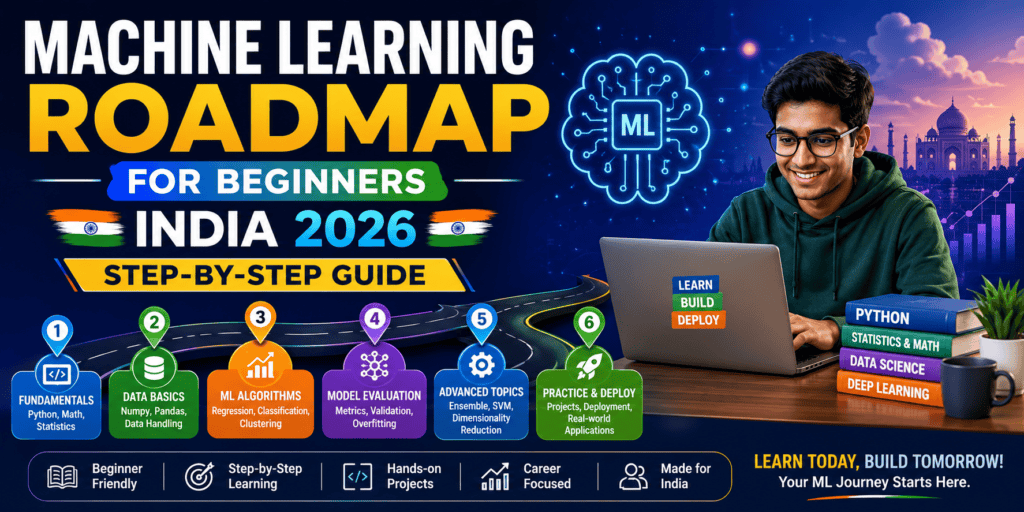
Machine Learning seekhne ka sahi order hai Mathematics foundation (2 months) → Python programming (2 months) → ML algorithms with scikit-learn (2 months) → Projects aur portfolio (2 months) → Specialization (2 months). Total 8-11 months mein job-ready ho sakte hain agar consistent practice ho.
Machine Learning Career India 2026 Mein Kyun Choose Karein?
- 💰 Entry-level ML Engineer salary India mein ₹6–12 LPA — non-tech roles se 2x zyada
- 📈 2.3 lakh+ ML job openings India mein 2026 mein active hain
- 🌏 Remote work opportunities — India se US, UK companies ke liye kaam karna possible
- 🚀 Generative AI boom ne ML skills ki demand 35% further increase kar di hai
- 🎓 Traditional degrees ki jagah skills + portfolio se bhi jobs milti hain
ML Roadmap Shuru Karne Se Pehle — Common Mistakes
Bahut beginners yeh galtiyan karte hain:
- ❌ Tutorial Hell — sirf videos dekhte rehte hain, practice nahi karte
- ❌ Math skip karna — foundation weak hone se baad mein problems aate hain
- ❌ Multiple languages ek saath — pehle Python master karo, baaki baad mein
- ❌ Project-less learning — bina projects ke resume empty rahta hai
- ❌ Perfectionism — “pehle sab seekh lenge phir start karenge” — kabhi nahi hota
Step-by-Step Machine Learning Roadmap
🔢 Step 1: Mathematics Foundation (4–6 Weeks)
ML samajhne ke liye math zaroori hai — lekin PhD-level nahi chahiye. Yeh topics enough hain:
Linear Algebra (Most Important):
- Vectors aur matrices — ML data isi format mein hota hai
- Matrix multiplication, transpose, inverse
- Eigenvalues aur eigenvectors (PCA ke liye)
- Dot product aur norms
Statistics aur Probability:
- Mean, median, mode, variance, standard deviation
- Normal distribution, Bayes’ theorem
- Hypothesis testing basics
- Correlation vs causation
Calculus (Basics Only):
- Derivatives aur chain rule (backpropagation ke liye)
- Partial derivatives
- Gradient descent concept
Resources:
- Khan Academy — completely free, excellent Hindi support
- 3Blue1Brown “Essence of Linear Algebra” YouTube series
- StatQuest with Josh Starmer YouTube channel
🐍 Step 2: Python Programming (4–6 Weeks)
Python ML ka universal language hai. Yeh libraries essential hain:
| Library | Kya Karta Hai | Priority |
|---|---|---|
| Python Basics | Variables, loops, functions, OOP | Must |
| NumPy | Numerical computations, arrays | Must |
| Pandas | Data manipulation, CSV handling | Must |
| Matplotlib | Basic data visualization | Must |
| Seaborn | Statistical visualizations | Good to have |
| Jupyter Notebook | Interactive coding environment | Must |
Practice Resources:
- Kaggle Python course — free, certificate milta hai
- LeetCode easy problems Python mein
- “Automate the Boring Stuff” book — free online
Milestone: Python mein ek simple data analysis project complete karo. Kaggle ki koi bhi tabular dataset lo, load karo, clean karo, visualize karo.
🤖 Step 3: Core ML Algorithms (6–8 Weeks)
Yeh sabse important step hai. Har algorithm ka intuition samjho — sirf code copy-paste mat karo.
Supervised Learning:
| Algorithm | Use Case | Difficulty |
|---|---|---|
| Linear Regression | Price prediction, continuous output | Beginner |
| Logistic Regression | Classification, binary output | Beginner |
| Decision Trees | Rule-based classification | Beginner |
| Random Forest | Ensemble, better accuracy | Intermediate |
| XGBoost/LightGBM | Competitions, high performance | Intermediate |
| Support Vector Machine | Complex classification | Intermediate |
| K-Nearest Neighbors | Simple classification | Beginner |
Unsupervised Learning:
- K-Means Clustering — customer segmentation
- Principal Component Analysis (PCA) — dimensionality reduction
- DBSCAN — anomaly detection
Model Evaluation (Critical!):
- Train-Test Split aur Cross Validation
- Confusion Matrix, Precision, Recall, F1 Score
- ROC-AUC curve
- Overfitting vs Underfitting samajhna
Best Tool: scikit-learn — Python ka ML Swiss Army knife
🔧 Step 4: Feature Engineering (3–4 Weeks)
Real-world data messy hota hai. Feature engineering woh process hai jisse raw data ko useful ML input banate hain.
Kya Seekhein:
- Missing values handle karna (imputation strategies)
- Outlier detection aur treatment
- Feature scaling — normalization aur standardization
- Categorical encoding — one-hot, label encoding, target encoding
- Feature selection — kaunse features useful hain kaunse nahi
- Creating new features from existing ones
Practice: Kaggle Titanic dataset — perfect feature engineering exercise
🧠 Step 5: Deep Learning Basics (6–8 Weeks)
Classical ML ke baad deep learning seekho — yeh images, text, aur complex patterns ke liye hota hai.
Kya Seekhein:
- Neural Networks architecture — layers, neurons, weights, biases
- Activation functions — ReLU, Sigmoid, Tanh, Softmax
- Forward aur backward propagation
- Gradient descent aur optimizers — Adam, SGD
- Convolutional Neural Networks (CNN) — image processing
- Recurrent Neural Networks (RNN) — sequential data
- Transfer Learning — pre-trained models use karna
Frameworks:
- TensorFlow + Keras — beginners ke liye easier
- PyTorch — industry preferred, research mein popular
Start with Keras — clean API, quick results milte hain.
🎯 Step 6: Specialization Choose Karo (4–6 Weeks)
Ek area mein deep dive karo — generalist se specialist valuable hota hai:
| Specialization | Tools | India Job Demand | Starting Salary |
|---|---|---|---|
| Computer Vision | OpenCV, YOLO, CNN | High | ₹8–14 LPA |
| NLP & Text AI | Hugging Face, BERT, Transformers | Very High | ₹8–15 LPA |
| Generative AI | LangChain, OpenAI API, RAG | Highest | ₹8–18 LPA |
| Time Series | Prophet, statsmodels | Medium | ₹6–12 LPA |
| MLOps | Docker, MLflow, Kubeflow | High | ₹10–18 LPA |
📁 Step 7: Portfolio Projects (Ongoing)
Beginner Projects:
- House Price Prediction — Kaggle Boston Housing dataset, Linear Regression
- Movie Sentiment Analysis — IMDb reviews, Logistic Regression / BERT
- Customer Churn Prediction — Telecom dataset, Random Forest + XGBoost
Intermediate Projects:
- Credit Card Fraud Detection — Imbalanced dataset, SMOTE, AUC-ROC
- Movie Recommendation System — Collaborative filtering, cosine similarity
- Hinglish Sentiment Analysis — India-specific, Twitter data
Advanced Projects:
- End-to-End ML Pipeline — Data → Model → FastAPI → Docker → AWS deployment
- RAG-based Chatbot — LangChain + OpenAI + Vector Database
- Real-time Object Detection — YOLO + webcam
GitHub pe upload karo — har project ka clean README likho, model performance document karo, live demo link add karo (Streamlit se easy hai).
🚀 Step 8: MLOps aur Deployment (4 Weeks)
Model banana enough nahi — production mein deploy karna seekho:
- Flask/FastAPI — model ko REST API mein convert karna
- Streamlit — quick ML web apps banana
- Docker — containerization basics
- Cloud deployment — AWS SageMaker ya Google Vertex AI basics
- MLflow — experiment tracking aur model registry
- GitHub Actions — basic CI/CD pipeline
🏆 Step 9: Certifications (Optional but Helpful)
| Certification | Provider | Effort | Value India |
|---|---|---|---|
| Google Professional ML Engineer | Google Cloud | High | Very High |
| AWS Machine Learning Specialty | Amazon | High | Very High |
| TensorFlow Developer Certificate | Medium | High | |
| Microsoft Azure AI Engineer | Microsoft | Medium | High |
| onlineeducationindia.com ML Cert | India-focused | Low-Medium | India market |
Complete Timeline Summary
| Phase | Duration | Focus |
|---|---|---|
| Mathematics Foundation | 4–6 weeks | Linear Algebra, Stats, Calculus basics |
| Python + Libraries | 4–6 weeks | NumPy, Pandas, Matplotlib, Jupyter |
| Core ML Algorithms | 6–8 weeks | scikit-learn, supervised + unsupervised |
| Feature Engineering | 3–4 weeks | Data preprocessing, feature creation |
| Deep Learning | 6–8 weeks | TensorFlow/PyTorch, CNN, RNN |
| Specialization | 4–6 weeks | NLP, CV, GenAI, MLOps |
| Projects + Portfolio | Ongoing | GitHub projects, Kaggle competitions |
| Total | 8–11 months | Job-ready |
Key Takeaways
- 🔢 Math pehle — linear algebra aur statistics foundation mein invest karo, shortcuts mat lena
- 🐍 Python ek hi language pehle master karo — phir frameworks seekho
- 📁 Projects most important hain — employers portfolio dekhte hain, certificate nahi
- 🎯 Specialize karo — generalist se specialist valuable hota hai India job market mein
- ⚡ Kaggle use karo — competitions + datasets + community — sab free hai
Frequently Asked Questions (FAQs)
1. Kya ML seekhne ke liye maths mein expert hona zaroori hai?
Nahi. High school level mathematics (12th standard) kaafi hai start karne ke liye. Linear algebra aur statistics ke specific topics seekhne ki zaroorat hai — poori mathematics nahi. Khan Academy aur 3Blue1Brown se koi bhi seekh sakta hai.
2. ML ke liye konsa laptop ya computer chahiye?
Minimum: 8GB RAM, i5/Ryzen 5 processor, 256GB storage. Better: 16GB RAM, dedicated GPU (NVIDIA preferred). Budget constraint hai toh Google Colab use karo — free mein GPU milti hai cloud pe, koi installation nahi.
3. Kitne Kaggle competitions karne chahiye portfolio ke liye?
Quality matters more than quantity. Top 20% finish in 2-3 competitions ek strong signal hai. Shuru mein past competitions practice ke liye use karo — tabhi join karo live competitions jab basics solid hon.
4. India mein ML job ke liye minimum qualification kya hai?
2026 mein: Python proficiency + ML fundamentals + 2-3 GitHub projects + preferably ek certification. Degree helpful hai lekin mandatory nahi. Strong portfolio ke saath non-CS background se bhi entry possible hai.
5. Self-study se ML seekhna possible hai ya course join karna zaroori hai?
Self-study possible hai — lekin completion rate 10-15% hai bina guidance ke. Structured course mein — jaise Machine Learning Course onlineeducationindia.com pe — mentorship aur accountability se learning faster aur more complete hoti hai.
6. NLP ya Computer Vision — kaunsa specialization better hai India mein?
Dono high demand mein hain. NLP (especially LLMs aur Generative AI) mein 2026 mein highest demand hai India mein — ChatGPT jaisi technologies ki wajah se. Computer Vision healthcare, automotive, aur manufacturing mein strong demand hai. Apni interest ke hisaab se choose karo.
Apna ML Journey Aaj Shuru Karo
- 🧠 Machine Learning Course — Structured roadmap with mentorship
- 🤖 Generative AI Course — Modern AI skills
- 📊 Data Science Course — Data analysis foundation
- ⚙️ AI Automation & Agents — Practical AI applications
8-11 months mein consistent practice se ML career possible hai — aaj pehla step uthao!