Everyone is talking about Artificial Intelligence, Machine Learning, and Data Science. Job portals are flooded with these titles. LinkedIn is full of professionals switching careers into these fields. And if you are a student or working professional wondering “What is the actual difference — and which one should I choose?” you are in the right place.
The confusion is real. Many people use these three terms interchangeably. But they are not the same. Understanding the difference between AI vs ML vs Data Science can save you months of misdirected effort and help you choose the right career path, the right course, and the right skills to build.
In this blog, we break down all three definitions, tools, salaries, career paths, and which one is the best fit for your background and goals.
What is the difference between AI, Machine Learning, and Data Science?Artificial Intelligence (AI) is the broadest field it is about making machines think and act like humans. Machine Learning (ML) is a subset of AI that focuses on teaching machines to learn from data. Data Science is a multidisciplinary field that uses statistics, coding, and domain knowledge to extract insights from data. All three are related, but each has a different focus, toolset, and career path. |
What is Artificial Intelligence (AI)?
Artificial Intelligence is the simulation of human intelligence in machines. An AI system can perform tasks that normally require human thinking — like understanding language, recognising faces, driving cars, or making decisions.
Simple definition: AI = making machines smart enough to think, reason, and act like humans.
- Examples of AI in daily life: ChatGPT, Alexa, Siri, Google Search, self-driving cars, fraud detection in banking, face unlock on your phone.
- Core branches of AI: Natural Language Processing (NLP), Computer Vision, Robotics, Expert Systems, Generative AI.
- Who builds AI? AI Engineers, Research Scientists, Prompt Engineers, AI Architects.
According to NASSCOM 2024, India needs over 1 million AI professionals by 2026. The demand is real — and it is growing fast.
What is Machine Learning (ML)?
Machine Learning is a subset of AI. Instead of manually programming rules, ML allows machines to learn patterns from data and improve their performance over time — without being explicitly told what to do.
Simple definition: ML = giving machines the ability to learn from data and make predictions.
- Examples of ML in daily life: Netflix recommendations, spam filters in Gmail, credit score predictions, dynamic pricing on Swiggy and Zomato, product recommendations on Amazon.
- Core types of ML: Supervised Learning, Unsupervised Learning, Reinforcement Learning, Deep Learning.
- Who builds ML models? ML Engineers, Data Engineers, AI Researchers, Deep Learning Specialists.
ML is the engine that powers most of today’s AI applications. If AI is the destination, ML is the vehicle.
What is Data Science?
Data Science is a multidisciplinary field that combines statistics, programming, and domain knowledge to collect, clean, analyse, and visualise data — and turn it into decisions and insights that businesses can act on.
Simple definition: Data Science = using data to answer business questions and solve real problems.
- Examples of Data Science in daily life: How Flipkart decides what to show on your homepage. How hospitals predict patient readmissions. How IPL teams select players using analytics.
- Core skills in Data Science: Python / R, SQL, Data Visualisation (Tableau, Power BI), Statistical Analysis, Machine Learning basics.
- Who works in Data Science? Data Analysts, Data Scientists, Business Intelligence Analysts, Analytics Managers.
Data Science is often the most accessible entry point for beginners, especially those coming from non-engineering backgrounds.
How Are AI, ML, and Data Science Related?
Think of them as three concentric circles:
|
The Relationship : Visualised Simply AI (Outermost Circle) : The broadest concept. The goal: intelligent machines. ML (Inside AI) : A method to achieve AI. Machines learn from data. Deep Learning (Inside ML) : A subset of ML using neural networks. Data Science (Overlaps with AI and ML): Uses ML models and statistical tools to extract insights, build dashboards, and drive data-based decisions. Bottom line: ML is part of AI. Data Science uses ML as one of its tools. All three work together but serve different purposes in an organisation. |
AI vs ML vs Data Science -Full Comparison Table
Here is the most detailed side-by-side comparison to help you understand exactly how these three fields differ:
|
Criteria |
Artificial Intelligence |
Machine Learning |
Data Science |
|
Definition |
Machines simulating human intelligence |
Subset of AI that learns from data |
Extracting insights from structured & unstructured data |
|
Scope |
Broadest field — includes ML, DL, NLP |
Narrower — focuses on learning algorithms |
Multidisciplinary — stats, coding, domain knowledge |
|
Goal |
Build intelligent systems that think & act |
Enable machines to learn without being programmed |
Find patterns, trends & actionable insights in data |
|
Key Techniques |
NLP, Computer Vision, Robotics, Planning |
Regression, Classification, Clustering, Deep Learning |
EDA, Statistical Modelling, Data Visualisation |
|
Tools Used |
TensorFlow, PyTorch, IBM Watson, OpenAI |
Scikit-learn, Keras, XGBoost, LightGBM |
Python, R, SQL, Tableau, Power BI, Excel |
|
Who Uses It |
AI Engineers, Research Scientists |
ML Engineers, Data Engineers |
Data Analysts, Data Scientists, Business Analysts |
|
Avg. Salary (India) |
₹8–25 LPA |
₹7–20 LPA |
₹6–18 LPA |
|
Difficulty Level |
Very High |
High |
Medium–High |
|
Best For |
Innovation, research & cutting-edge tech |
Building predictive & recommendation models |
Business analytics & data-driven decisions |
|
Industries |
Healthcare, Defence, Automotive, Finance |
E-commerce, Fintech, Edtech, Healthcare |
Marketing, Banking, Retail, Government |
|
Time to Learn |
2–4 years (with CS background) |
12–18 months |
6–12 months (basics to job-ready) |
|
Top Certifications |
Google AI, MIT AI, Coursera Deep Learning |
Andrew Ng ML Coursera, AWS ML Specialty |
IBM Data Science, Google Data Analytics, IIT Madras |
AI vs ML vs Data Science – Salary Comparison in India
One of the biggest questions working professionals ask is: which pays more? Here is an honest look at salary ranges in India across experience levels:
|
Experience Level |
AI Engineer (LPA) |
ML Engineer (LPA) |
Data Scientist (LPA) |
|
Fresher (0–1 yr) |
₹4–8 LPA |
₹4–7 LPA |
₹3.5–7 LPA |
|
Mid-level (2–4 yrs) |
₹10–18 LPA |
₹8–15 LPA |
₹7–14 LPA |
|
Senior (5+ yrs) |
₹20–40+ LPA |
₹16–30 LPA |
₹14–28 LPA |
|
Top MNCs / Startups |
₹30–60+ LPA |
₹25–50 LPA |
₹20–45 LPA |
Source: Glassdoor India, AmbitionBox, Naukri.com salary insights (2024–2025 data). Salaries vary by company, city, and skill depth.
Which is Best for You?- AI vs ML vs Data Science
There is no single answer to which is the “best” field. The right choice depends on your background, interest, and career goal. Here is a simple guide:
Choose Artificial Intelligence if…
- You have a strong computer science or engineering background.
- You enjoy working on cutting-edge, research-oriented problems.
- You want to build products like ChatGPT, self-driving cars, or smart robots.
- You are comfortable with advanced mathematics — linear algebra, calculus, probability.
- You want to work at companies like Google, Microsoft, ISRO, or AI startups.
Choose Machine Learning if…
- You enjoy building predictive models and solving specific, well-defined problems.
- You want to work in e-commerce, fintech, healthcare, or recommendation systems.
- You are comfortable with Python and want to work with large datasets.
- You want a balance between research and practical application.
- You aim for roles at companies like Flipkart, Swiggy, PhonePe, or Amazon.
Choose Data Science if…
- You are from a non-engineering background (commerce, science, arts, BBA).
- You enjoy analysing trends, building dashboards, and storytelling with data.
- You want to add data skills to your existing domain knowledge (marketing, finance, HR).
- You prefer a shorter learning curve to get job-ready faster.
- You want to work as a Business Analyst, Data Analyst, or BI Analyst.
Career Path Recommendations by Background
|
Your Background |
Best Starting Point |
Ideal Career Path |
|
Commerce / BBA Graduate |
Data Science |
Data Analyst → Business Analyst → Data Scientist |
|
Computer Science Engineer |
Machine Learning |
ML Engineer → AI Engineer → Research Scientist |
|
Working Professional (Non-tech) |
Data Science |
SQL + Excel → Data Analyst → BI Analyst |
|
Working Professional (Tech) |
Machine Learning |
ML Engineer → Data Engineer → AI Architect |
|
Maths / Stats Graduate |
Data Science or ML |
Statistician → Data Scientist → Quant Analyst |
|
Designer / Marketer |
Data Science |
Marketing Analyst → Growth Hacker → AI Marketer |
Top Skills to Learn in Each Field
Must-Have Skills for AI
- Python (advanced) + C++ basics
- Linear Algebra, Calculus & Probability
- Deep Learning — TensorFlow, PyTorch
- Natural Language Processing (NLP) & Transformers
- Computer Vision (OpenCV, YOLO)
- Generative AI & Prompt Engineering (most in demand in 2025)
Must-Have Skills for Machine Learning
- Python — NumPy, Pandas, Scikit-learn
- Supervised & Unsupervised ML algorithms
- Feature Engineering & Model Evaluation
- Deep Learning basics — Keras, TensorFlow
- MLOps — deploying and monitoring ML models
- Cloud ML — AWS SageMaker, Google Vertex AI
Must-Have Skills for Data Science
- Python or R for data analysis
- SQL — querying databases
- Excel & Google Sheets — for quick analysis
- Data Visualisation — Tableau, Power BI, Matplotlib
- Statistics — hypothesis testing, regression, probability
- Basic ML — understanding and applying models (not building from scratch)
Top Companies Hiring in India – AI vs ML vs Data Science
|
AI Engineers |
ML Engineers |
Data Scientists |
|
Google India |
Amazon (AWS) |
Accenture |
|
Microsoft Azure AI |
Flipkart |
Deloitte |
|
ISRO / DRDO |
PhonePe / Razorpay |
HDFC Bank / ICICI |
|
IBM Research |
Swiggy / Zomato |
TCS, Infosys, Wipro |
|
Startups (GenAI space) |
Ola, Uber, Meesho |
MakeMyTrip, Myntra |
Best Online Courses to Get Started in India
For Artificial Intelligence
- IIT Madras Online BSc in Data Science & AI (UGC Recognised)
- Google AI + DeepMind Fundamentals (Free, Coursera)
- MIT OpenCourseWare: Introduction to Deep Learning
- Coursera: AI for Everyone by Andrew Ng (Beginner friendly)
For Machine Learning
- Coursera: Machine Learning Specialisation by Andrew Ng
- ai: Practical Deep Learning for Coders (Free)
- AWS Machine Learning Specialty Certification
- IIT & IISc ML courses on NPTEL (Free, with certificate)
For Data Science
- IBM Data Science Professional Certificate (Coursera)
- Google Data Analytics Certificate (Coursera)
- IIT Madras Online Degree in Data Science
- Kaggle Learn — Python, SQL, Data Viz (100% Free)
Key Takeaways
|
Key Takeaways : AI vs ML vs Data Science • AI is the broadest field it is about building intelligent machines. • Machine Learning is a subset of AI that enables machines to learn from data. • Data Science uses data + statistics + ML to extract business insights. • All three are related but they have different goals, tools, and career paths. • Data Science is the most accessible starting point for non-tech backgrounds. • ML is best for those who enjoy building predictive models and working with large datasets. • AI (especially Generative AI) is the fastest-growing and highest-paying field in 2025. • The best field for you depends on your background, interest, and career goal not just salary. |
Frequently Asked Questions
1. Is AI and Machine Learning the same thing?
No. AI is the broader concept — the goal of making machines intelligent. Machine Learning is one method used to achieve AI. All ML is a part of AI, but not all AI uses ML. For example, rule-based expert systems are AI but not ML.
2. Which is easier to learn AI, ML, or Data Science?
Data Science is generally considered the easiest entry point, especially for non-programmers. It requires less advanced mathematics than AI or ML. Machine Learning is next in difficulty. AI (especially deep learning and generative AI) is the most complex and requires the strongest mathematical foundation.
3. Which field has the best salary AI, ML, or Data Science in India?
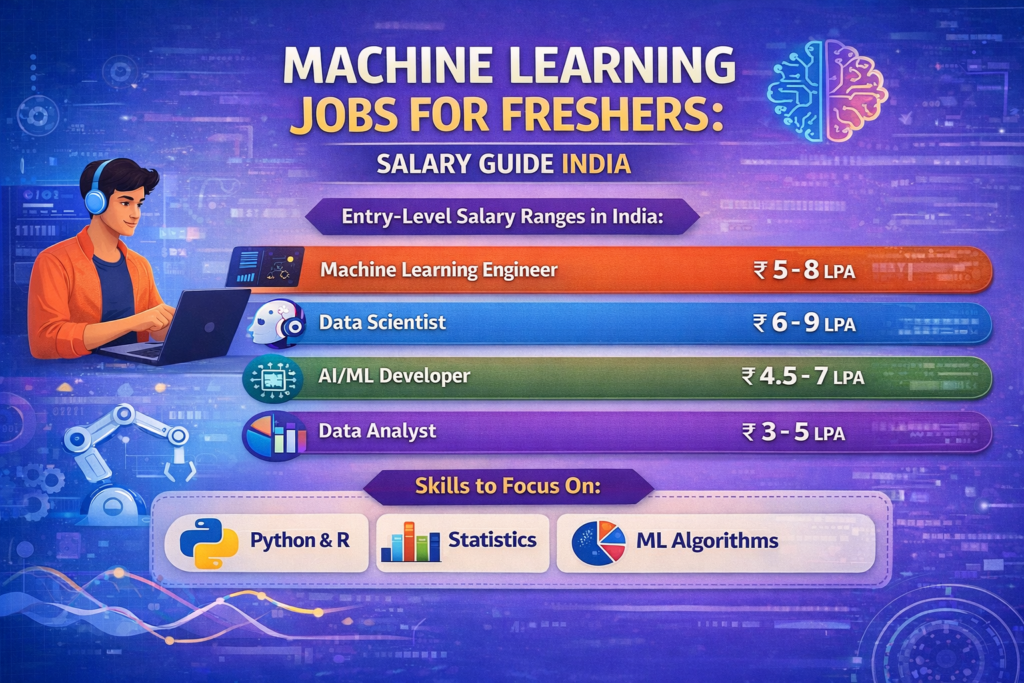
AI Engineers typically earn the most, followed by ML Engineers, and then Data Scientists. However, all three fields offer strong salaries — ranging from ₹6–8 LPA for freshers to ₹30–60+ LPA for senior professionals at top companies. Skills depth and experience matter more than the job title.
4. Can I learn Data Science or ML without a coding background?
Yes. Many working professionals from commerce, marketing, finance, and even the arts have successfully transitioned into Data Science by learning Python and SQL from scratch. Tools like Tableau and Power BI also allow non-coders to work with data professionally. Start with the basics and build gradually.
5. What is the difference between a Data Scientist and an ML Engineer?
A Data Scientist focuses on analysing data, building models, and communicating insights to business stakeholders. An ML Engineer focuses on building, deploying, and scaling ML models in production. Data Scientists work more on the research and insight side; ML Engineers work more on the engineering and infrastructure side.
6. Is Generative AI a part of AI, ML, or Data Science?
Generative AI (like ChatGPT, Midjourney, and Gemini) is a subfield of AI and uses advanced ML techniques like deep learning and transformer models. It sits at the intersection of all three fields but is primarily categorised under AI and Deep Learning. It is the fastest-growing and most in-demand specialisation in 2025.
7. Which field should a working professional with 5 years of non-tech experience choose?
Start with Data Science. It has the lowest barrier to entry, the fastest time to employment, and allows you to leverage your existing domain knowledge (finance, marketing, operations) alongside new data skills. Once comfortable, you can move into ML as your technical depth grows.
Our Recommendation -Which Should You Choose?
|
Expert Pick for Indian Students & Professionals If you are a complete beginner → Start with Data Science. If you have a coding background → Go for Machine Learning. If you want the highest salary & cutting-edge work → Aim for AI (Generative AI). If you are a working professional → Data Science first, then upskill to ML. The best strategy: Learn Data Science basics first (3–6 months), add ML next (6–12 months), and keep an eye on AI trends. This layered approach builds a rock-solid foundation and keeps you highly employable at every stage. |
Conclusion: AI vs ML vs Data Science All Three Have a Place
The debate of AI vs ML vs Data Science is not about which is better it is about which is better for you. All three fields are booming in India. All three offer excellent career growth, strong salaries, and long-term job security in a data-driven world.
The key is to start. Pick one based on your background, commit to learning for 6–12 months, build real projects, and apply consistently. The Indian job market is actively hiring across all three fields — and it will continue to do so for the next decade.
|
Need help choosing the right AI, ML, or Data Science course for your career? Get free, unbiased guidance from experts at Online Education India. Visit: https://onlineeducationindia.com/ Email: info@onlineeducationindia.com Call / WhatsApp: +91 94057-04098 We help Indian students and working professionals find the right course honestly. |